


Nene, Hawaii’s State Bird

Updated: Apr. 24, 2020




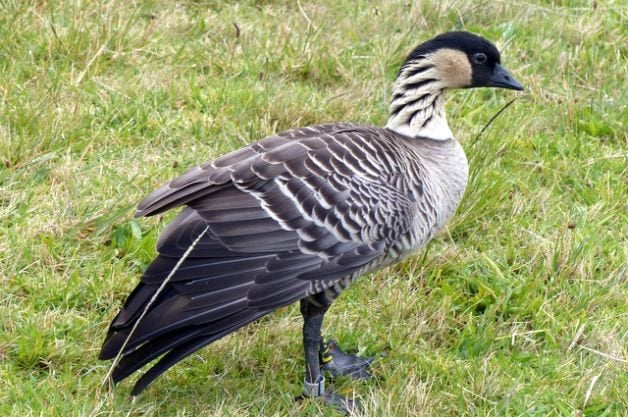
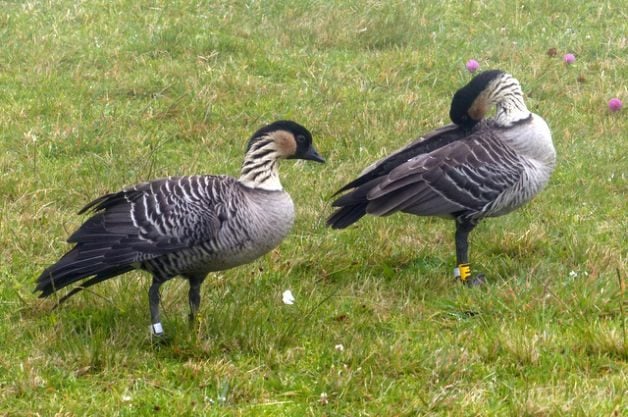
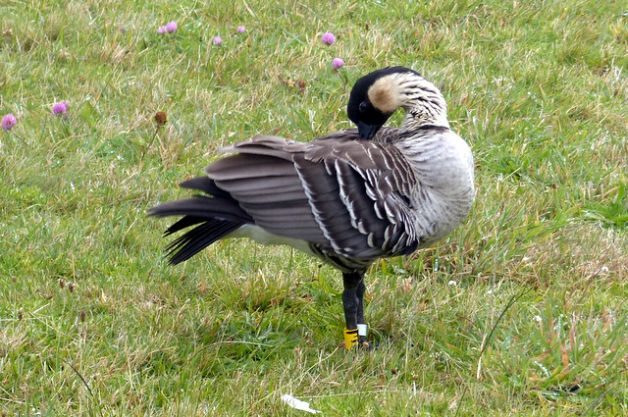
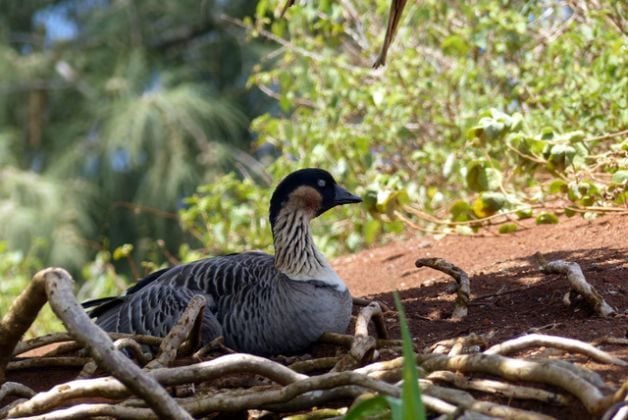
A close relative of the Canada Goose, the Nene is the rarest of all the state birds and found only in Hawaii.
The story of Hawaii’s state bird, the Nene (“Nay-Nay”), got its start in an unexpected place. Take a trip through time and imagination as we trace the history of the Hawaiian Goose.
Picture a cold wind-swept plain in the far northwest of what would later become North America, half a million years ago. Humans as we know them do not yet walk the Earth, and not far to the north lurk huge ice sheets stalked by sabre tooth tigers and wooly mammoths. Huddled on this plain are a group of geese that look quite familiar to modern eyes, though: Canada Geese (Branta canadensis) preparing for their yearly migration south. Trouble strikes, though – as they begin their journey, a massive storm catches the flock, flinging it far off course into the western seas. They travel for days and weeks, looking for land. They’re engineered for long flights, but they need land to rest and breed, so they continue on.
At last, in the distance, they see land break the surface of the water. As they draw nearer, the land is bleak and desolate, black and empty, still molten and explosive in many places. This large island, the one later to be known as “The Big Island” of Hawaii, is no place to land. At least, not yet. They head west, where the neighboring islands are a little older, a little more conducive to life. They land at last, Canada Geese so very far from home.
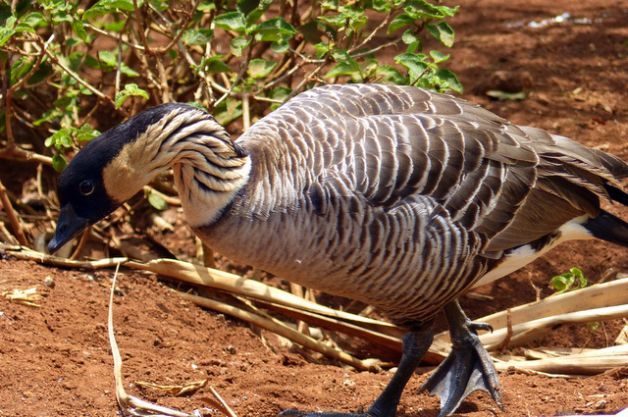
Years pass, hundreds of thousands of them. Slowly, the geese begin to evolve. This new land has fewer swampy patches and freshwater lakes than their homeland, so each generation becomes more adapted to eating grains and living on solid ground. They take to open water occasionally to breed, but they don’t require it. Long migrations to avoid cold winters aren’t necessary here, so their wings become shorter. Their toes develop padding and the webbing between them grows less, making it easier for them traverse cooled lava flows. This is now a new species, Branta sandvicensis, which later settlers will call the Nene for its distinctive call.
It is many more thousands of years before these settlers first set eyes on these birds, a scant 1000 years ago or so. Early inhabitants bring agriculture and larger mammals, changing the landscape in seemingly subtle ways. They hunt the birds, but in manageable numbers. The Nene lives alongside humans for hundreds more years, and when Captain James Cook arrives in 1778 it is believed there are at least 25,000 of them living on the islands. Now change comes more swiftly. Sailors hunt the birds in huge numbers to feed hungry crews. Feral dogs and cats kill the birds, and other introduced animals prey on their eggs. By 1952, scientists can find only 30 Nene still living in the wild in Hawaii.
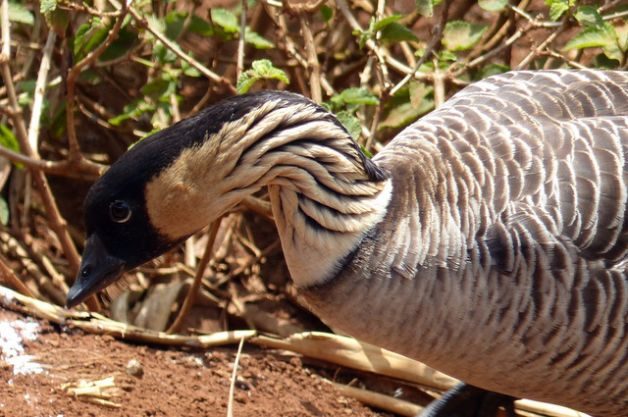
Fortunately, they act in time. Captive breeding programs begin, with new Nene populations released back into their original ranges over time. Recent estimates put their population now at about 2,500 birds, found on three of the four largest islands. Visitors can spot them reliably on Haleakala in Maui, Volcanoes National Park on The Big Island, Kilauea Point NWR on Kauai. They’re protected by law, as well as being Hawaii’s state bird, and beloved by tourists and native Hawaiians alike. The Nene is a fascinating story of evolution, of adaptation, of protection, of conservation – a perfect symbol for the state it represents.
Note: While we do know that the ancestors of the Nene were Canada Geese, which arrived in the Hawaiian islands about 500,000 years ago, we don’t know precisely how they might have gotten there – I’m just offering one possibility here. Learn much more about the evolution of Nenes from Canada Geese via National Geographic by clicking here. Track recent sightings on eBird, and learn more about the species from the Cornell Lab of Ornithology.
Originally Published: September 24, 2016

