

How to Identify and Attract an Anna’s Hummingbird

Updated: Nov. 06, 2023




The Anna's hummingbird is more cold-hardy than most hummingbirds. Learn what the males and females look like and where to spot them.
On This Page
What Does an Anna’s Hummingbirds Look Like?
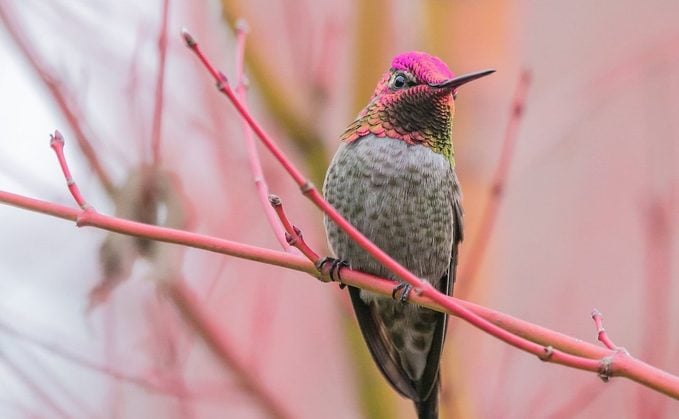
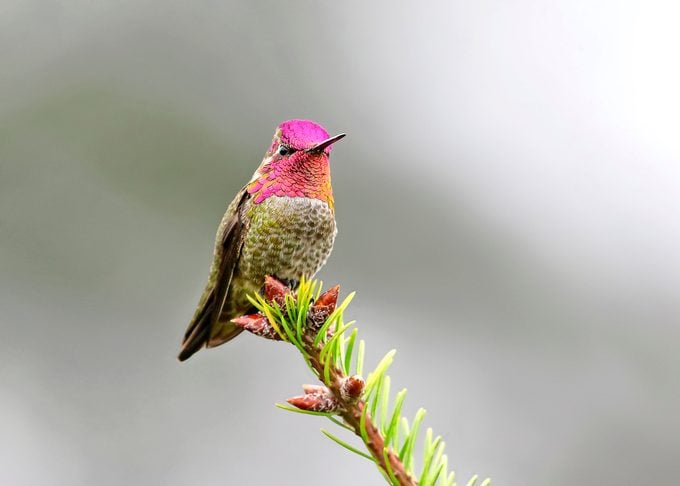
A stocky, medium-sized hummingbird, the Anna’s has a straight, short bill and a broad tail that extends past the wings. With bold, metallic greens above a gray belly, Anna’s is the only North American hummingbird sporting a full reddish crown. The male Anna’s hummingbird has a beautiful iridescent pinky rose-red colored crown and throat.
If the color appears to be more violet than rose, the bird could be a hybrid that is the result of mating between Anna’s and Costa’s hummingbirds.
The female has a red patch on the throat, often forming a small gorget that is unusual for female hummingbirds. Their backs are duller, iridescent green, with drab gray underparts, and they have white markings over the eyes.
These hummingbirds are quite small, measuring about 3.9 inches from beak to tail (and weighing only 0.1 to 0.2 ounce). They have a wingspan of 5 1/4 inches.
Learn how to identify ruby-throated hummingbirds.
Anna’s Hummingbird Facts
- Scientific name: Calypte anna
- Family: Hummingbird
- Named for: Anna de Belle Massena, the wife of a French prince and bird collector
- Body temperature: Though it may seem very warm to humans, an Anna’s average body temperature is 107 degrees Fahrenheit. But it can drop to 48 degrees when it goes into torpor, a kind of deep sleep, during cold weather. It takes about 20 minutes to “awaken.”
- Heart rate: An average human heart beats between 60 and 100 times per minute, but an Anna’s heart rate is much faster, beating around 600 times per minute!
- Feet: Similar to other hummingbirds, Anna’s take zero steps because of their very small feet and legs. Instead, they rely on flying and landing to move around.
Check out more jaw-dropping facts about hummingbirds.
Anna’s Hummingbird Nest
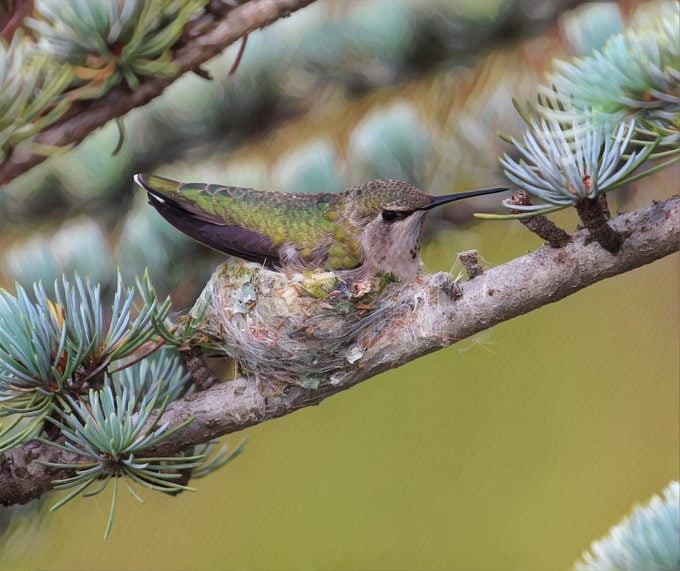
Anna’s hummingbirds breed in winter and spring. After mating, the female uses spider silk to bind together pieces of plants, hair, feathers and lichen to make a nest among twiggy branches of a tree or vine.
“This Anna’s hummingbird (above) made a tiny nest, and I watched two babies hatch and grow up in it. The mom fed the babies every 15 minutes. I took a number of photos, and even rescued one of the babies that fell out of the nest after consulting an expert on how best to rescue a hummingbird baby. I learned that hummingbirds have no sense of smell, so you can safely rescue a hatchling if it falls. Over a few weeks, I watched as they grew in size, eventually tested their wings and then flew away. Both made it! This hummingbird mom was amazing,” says Birds & Blooms reader Scott Rose 0f Victoria, British Columbia.
Juvenile Anna’s Hummingbirds
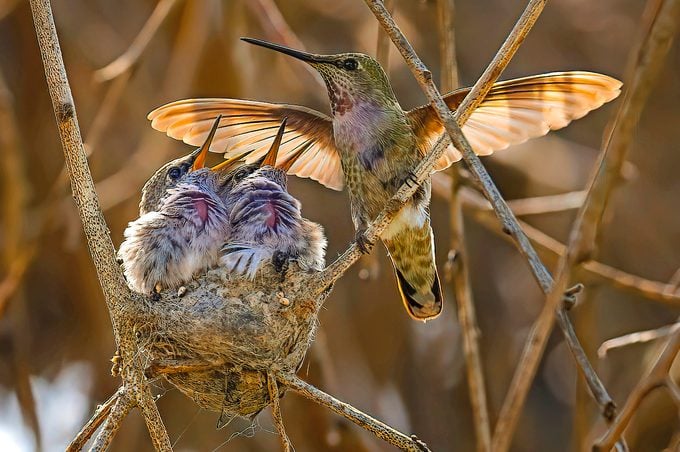
Two pearly white eggs hatch in two weeks, and the chicks fledge three weeks later.
Young Anna’s hummingbirds take to the skies at an early age—they’re typically between 18 and 26 days old when they set off on their first flights.
Learn everything you need to know about hummingbird nests.
Anna’s Hummingbird Call and Sounds
Anna’s hummingbirds are more vocal than most hummingbirds. The male sings a buzzy, scratchy series of notes to attract a mate. This is rare among northern temperate hummingbirds, though their squeaks and buzzes are hardly musical to the human ear.
Listen to their song.
Bird songs provided by the Cornell Lab of Ornithology.
If you’re lucky enough, you may see a male Anna’s hummingbird perform a unique courtship ritual. To attract a mate, the male puts on an aerial display that starts with hovering a few yards in front of a female. He ascends above the treetops, then dives toward the ground, pulling up with a loud screech made by his tail feathers. He does the same to intimidate intruders (including people). The male zooms upwards as much as 130 feet when performing this display.
What Do Anna’s Hummingbirds Eat?
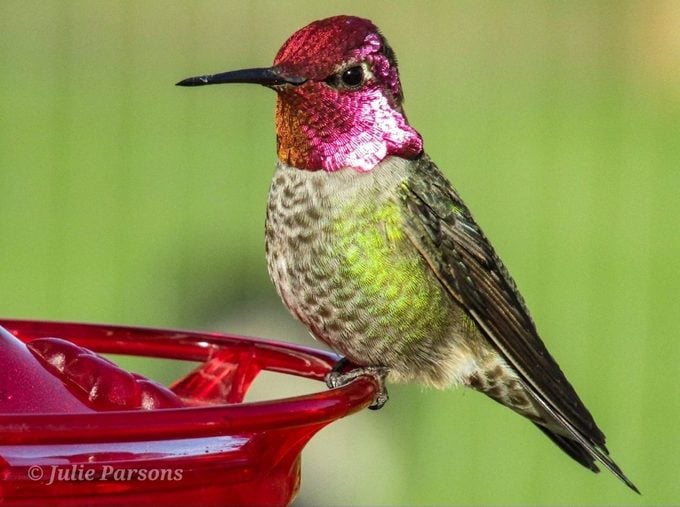
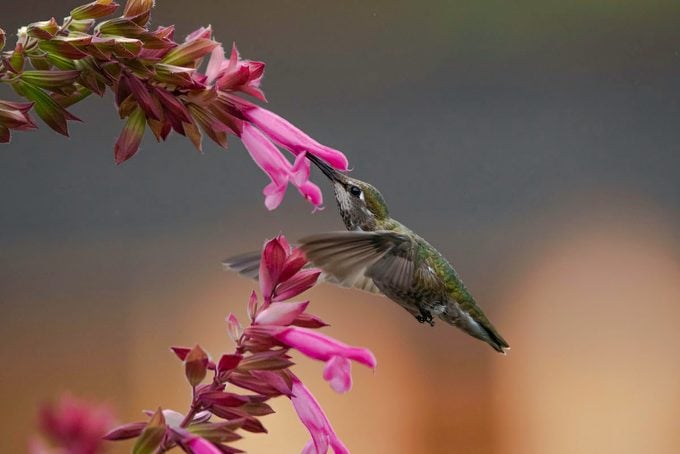
Generally, their favorite foods are nectar, sugar water, spiders, small insects like midges and leaf hoppers and tree sap. The high-protein diet might help them tolerate colder conditions.
“What do Anna’s hummingbirds eat for food when they stay in Washington during the winter?” asks Birds & Blooms reader William Toth.
Birding experts Kenn and Kimberly Kaufman say, “In recent decades, Anna’s hummingbirds have extended their year-round range north, along the Pacific coast to Washington and British Columbia. Thanks to the effects of ocean currents, that coastal region has a mild climate in all seasons. For example, average nighttime low temperatures in Seattle, Washington, are well above freezing, even in midwinter.
During the winter, there are usually plenty of flowers blooming in gardens and natural areas, and tiny insects are active during the day. Many people in these areas put out sugar-water feeders, which helps the hummingbirds survive through extreme cold snaps.”
Anna’s Hummingbird Range Map
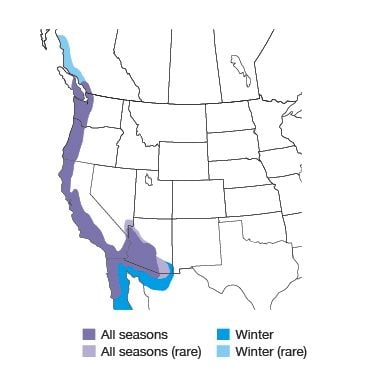
Range maps provided by Kaufman Field Guides, the official field guide of Birds & Blooms.
This species is more cold-hardy than other hummingbirds. Look for them year-round along the Pacific Coast, as far north as British Columbia. A familiar sight from California up to Washington state, Anna’s visit backyard gardens, parks, streams and open woodlands.
Psst—you won’t believe how many Anna’s hummingbirds visited this Washington backyard!
Anna’s range and numbers have grown thanks to feeders and their attraction to both ornamental and native flowers. During the early 1900s, they were found primarily in northern Baja California and southern California. Anna’s hummingbirds now sometimes wander north to Alaska. Their range also extends eastward into Arizona, Nevada, Utah and western Texas, though they’ve been spotted as far away as New York and Newfoundland.
Outside the breeding season, they may move to higher elevations in search of food, and some migrate east and west across California and Arizona.
Next, learn how to identify and attract a rufous hummingbird.
Originally Published: November 06, 2023

