

Everything You Need to Know About Hummingbird Nests


Updated: May 11, 2023




Watching hummingbirds is more fun when you find a hummingbird nest with hummingbird eggs. Learn how to attract these tiny fliers to nest in your yard.
Like a crown jewel, a hummingbird nest is one of the great wonders in all of nature. They are so tiny, so perfect. Yet, few of us have ever seen a hummingbird nest. This is because they are nearly impossible to find. From the ground, they look like another bump on a branch. From above, an umbrella of leaves conceals them. And from the side, they look like a tiny knot, quilted with lichens, plant down and fibers. Though each of the 17 hummingbird species that breed in North America builds slightly different nests in various habitats, all hummingbird nests have much in common.
Check out these amazing facts and pictures of baby hummingbirds.
Hummingbird Nest Facts
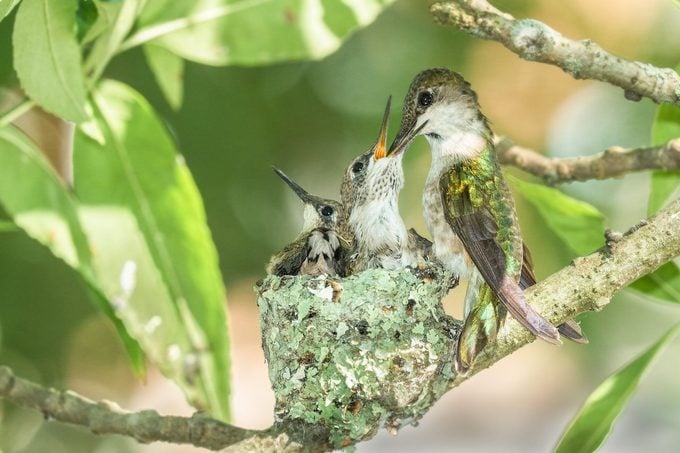
- Female hummingbirds build their nests 10 to 90 feet high, generally in trees or shrubs (with a few exceptions).
- Hummingbirds build velvety, compact cups with spongy floors and elastic sides that stretch as the young grow. They weave together twigs, plant fibers, and bits of leaves, and use spider silk as threads to bind their nests together and anchor them to the foundation.
Will a hummingbird nest in a birdhouse? Here’s what you should know.
Hummingbird Eggs
- Hummingbird eggs are about the size of navy beans.
- Most females lay two eggs, which they incubate for 15 to 18 days.
- Juvenile hummingbirds fledge (leave the nest) 18 to 28 days after hatching.
Attracting Hummingbirds to Nest
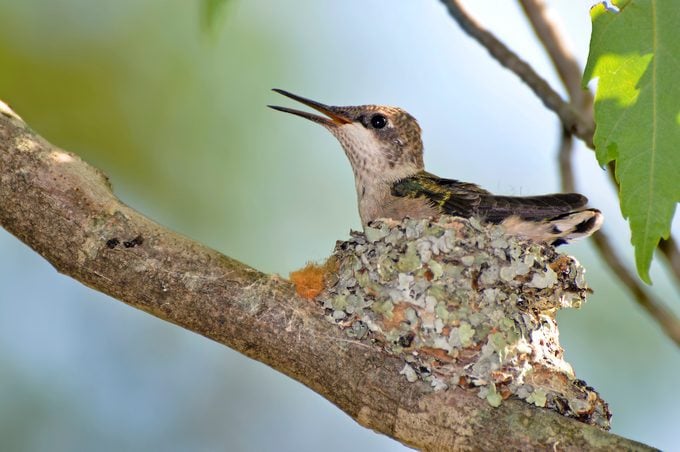
Any hummingbird lover knows that adding nectar plants to your garden is an important part of attracting hummingbirds. But these tiny creatures rely on a different set of plants for nesting materials. Add some of these to your garden to encourage hummingbirds to nest nearby.
Hummingbirds don’t use nest boxes or tree cavities. Instead they generally build their nests in sheltered trees or shrubbery, often in a fork of branches. Enhance your own hummingbird habitat by growing a diversity of leafy trees and large shrubs that provide shelter at varying heights. And if you want to get more bang for your buck, plant catkin-bearing trees and shrubs, which provide soft plant fibers for nesting material. Some examples of these include willows, witch hazel, alder, American elm, cottonwood, ironwood, poplar, birch, beech, mulberry and maple.
Psst—don’t miss these hilariously funny hummingbird photos!
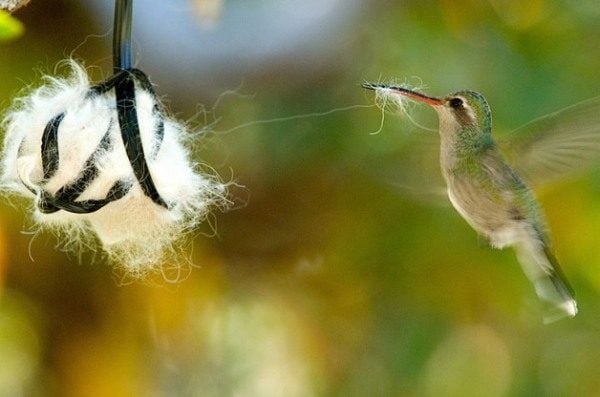
Hummingbird eggs are cradled in soft fluffy fibers that hummingbirds choose from plants nearby. Add plants with fuzzy foliage like lamb’s ear (Stachys byzantine), which forms dense, ground-hugging rosettes of thick, soft, woolly leaves. The silken plumes of ornamental grasses are also useful in attracting hummingbirds looking to nest. Some plants have seed heads or pods that transform into fuzzy balls of soft fiber, or are encased in soft protective casings. Examples include clematis, honeysuckle, milkweed (Asclepias species) and blanket flower (Gaillardia species). Pasque flowers offer both soft foliage with silken hairs, and mid-spring flowers followed by fuzzy seedpods.
Check out more jaw-dropping facts about hummingbirds.
Hummingbird Nest Characteristics by Species
While these are the basics for hummingbird nests, it is interesting to see what makes each of these species unique. Hal Harrison studied hummingbird nests for decades—here are some of his observations.
- Anna’s hummingbird females build a mere platform as early as December to lay her eggs. Then she builds up the nest while incubating.
- Black-chinned hummingbird nests are deep cups, and the rim may be curved inward.
- Blue-throated hummingbird nests are often built on electric wire inside or outside of cabins.
- Broad-billed hummingbirds will build their loosely constructed nests on clotheslines.
- Broad-tailed hummingbirds often returns to same nesting site year after year.
- Calliope hummingbirds will build a series of two, three or even four nests on top of one another, often attached to a conifer cone.
- Costa’s hummingbirds will colonize at favorable sites with as many as six nests in a 100-foot radius. The birds are very tame at nesting sites.
- Rivoli’s hummingbirds build the largest and highest of North American hummingbird nests.
- Ruby-throated hummingbird females attach their nests with spider silk to a small twig or branch that slants downward and covers the outside with greenish-gray lichens. They may lay eggs in a second nest while still feeding the young in the first.
- Rufous hummingbirds, a western species, are very pugnacious around the nest, often driving away much larger birds.
Are hummingbirds territorial at feeders and flowers?
Do Hummingbirds Reuse Their Nests?
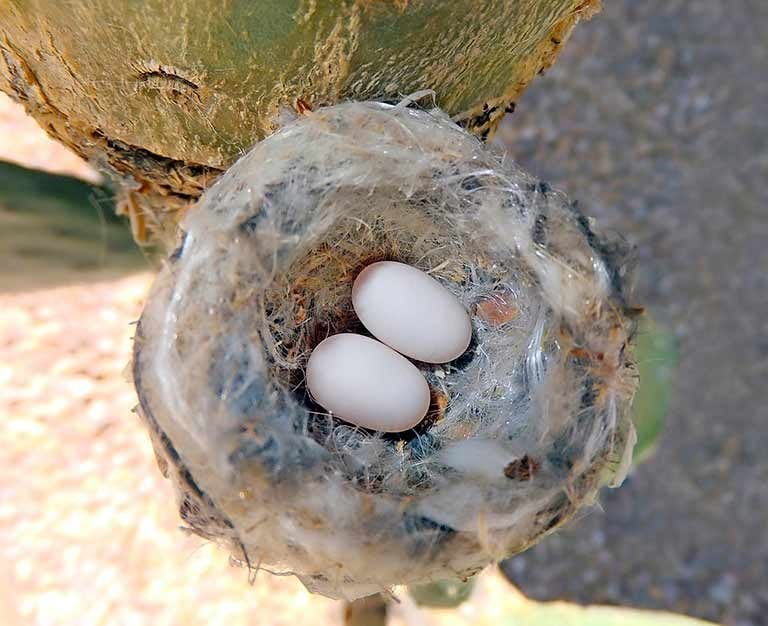
“One day I found two hummingbird nests in my tree. Do they reuse their nests or build new ones?” asks Birds & Blooms reader Kriss Reiff of Grand Junction, Colorado.
Kenn and Kimberly Kaufman: A hummingbird nest is a tiny marvel. Female hummingbirds use the finest plant fibers and spiderwebs to craft a secure cradle for eggs and young. It’s strong for its size, but such a nest is not durable enough for repeated use. Typically, the hummingbird mom will build a new nest for each brood, even within the same year. She may start construction before she finishes feeding the full-grown young from a previous one. In rare cases, a location is so good that females build right on top of the remains of the old nest.
Next, find out if hummingbirds mate for life.
Originally Published: January 20, 2023


